
Norris delivers tough McLaren verdict: front-row pace but eighth in Austin
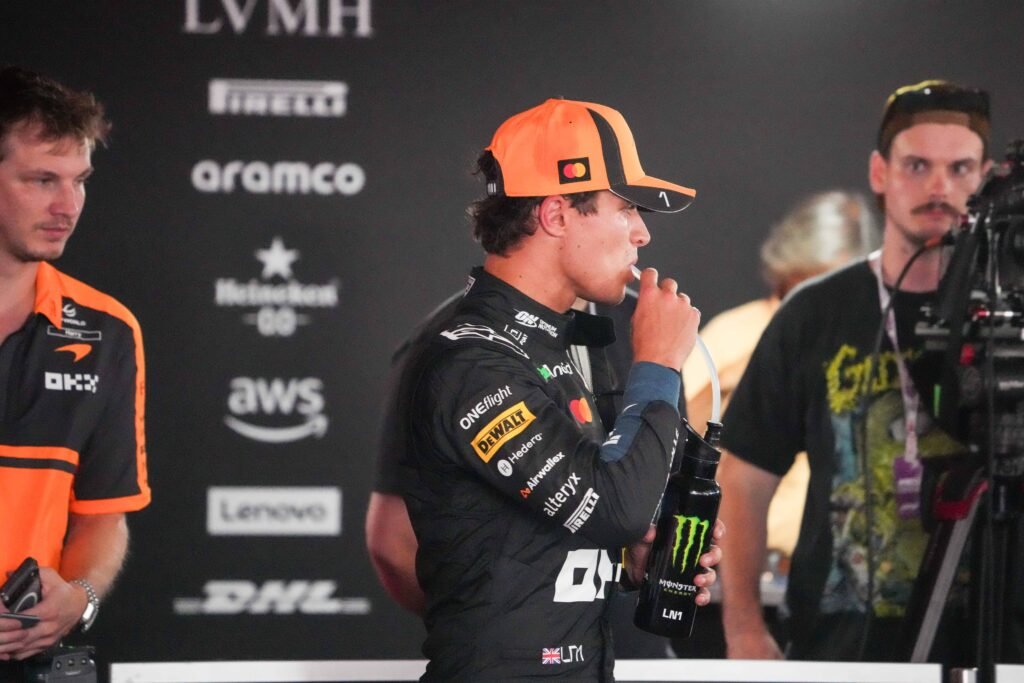 Photo: LAP.bg
Lando Norris qualified eighth for the United States Grand Prix and described his McLaren as possibly the hardest car he has ever driven. The Briton believes second place was within reach, but he could not translate that potential into a clean lap when qualifying reached its decisive stage.
A promising start unravels in Q3
Norris topped Q1, but the final session proved far more difficult. A gust of wind in the last sector compromised his opening attempt, while his second lap was deleted for exceeding track limits. Even if that final lap had counted, it would only have moved him up to sixth.
The Briton accepted responsibility for the outcome. In his assessment, the car was fast enough for the front row, and finishing eighth showed he had not extracted the performance available.
Piastri also struggles for consistency
Oscar Piastri finished seventh and reported similar difficulties. The Australian explained that the potential appeared in individual sections, but putting together a complete competitive lap was extremely challenging. He linked those problems to a car that must constantly be driven at the edge of its grip.
Austin’s bumps and sequences of corners make that task even more demanding. In his view, a small departure from the ideal line or balance can quickly become a substantial loss of lap time. Trying to compensate for the deficit to Mercedes and Red Bull also increases the risk of exceeding the circuit boundaries.
A fourth-row start and a difficult Sunday task
The two drivers’ positions leave McLaren needing to recover ground from the opening stages. Both Ferraris and George Russell qualified ahead, along with the leading trio of Antonelli, Verstappen and Hadjar.
Saturday’s result underlined that speed in isolated parts of a lap is not enough to secure a strong qualifying position. McLaren needs more predictable behaviour that allows its drivers to attack consistently. After seventh and eighth in qualifying, that consistency will be central to the team’s chances of progressing through the field in the race.
Source: RACER.