How Can Antonelli Become F1 World Champion at the US GP?
The youngest points leader in F1 history arrives in Austin with the arithmetic to crown himself early — if he can bring himself to say it out loud.
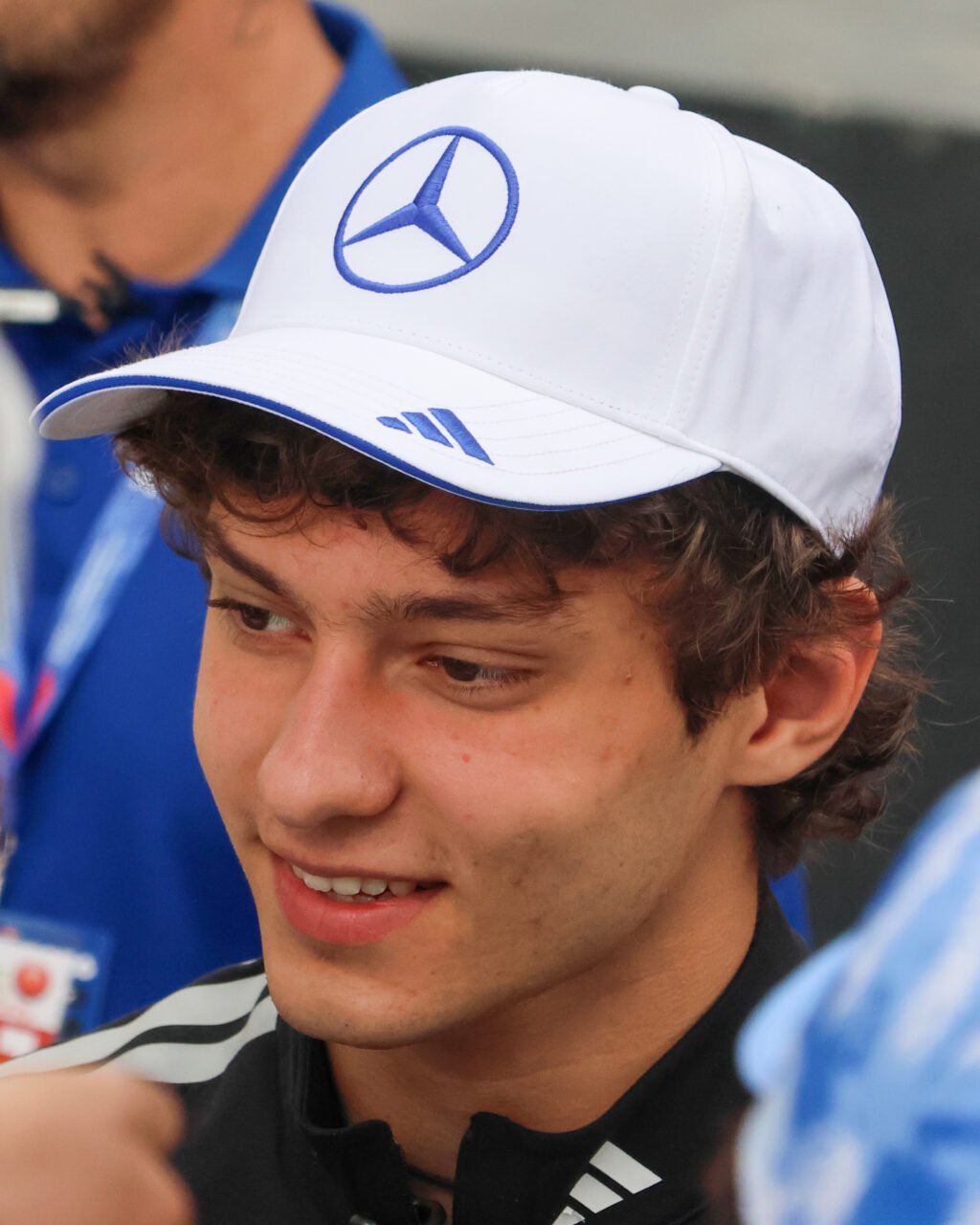 Photo: Yu Chu Chin / Wikimedia Commons (CC BY-SA 4.0)
Photo: Yu Chu Chin / Wikimedia Commons (CC BY-SA 4.0)
There is a particular kind of discomfort that comes with being the best person in the room before you have any business being the best person in the room. Andrea Kimi Antonelli has spent all of 2026 wearing that discomfort like a borrowed suit — 340 points into a season he began as Mercedes’ most expensive what-if, he now arrives in Austin with the title close enough to touch, and young enough that even saying so out loud makes him flinch. “Can I? Really?” he asked, when someone put the maths in front of him after Singapore. It was not false modesty. It was the sound of a twenty-year-old being told he might skip the rest of the syllabus.
In this story:
- What Austin actually requires
- The homework Mercedes still has to hand in
- 2010: Vettel’s 23 years and 134 days
- 2002: Schumacher’s six-race head start
- A student who keeps checking his own workings
- Would Austin be too early for Antonelli?
What Austin actually requires
The numbers, at least, are not ambiguous. Antonelli leaves Singapore with 340 points, 102 clear of Mercedes teammate George Russell, 111 ahead of Lewis Hamilton, 119 up on Max Verstappen and 125 in front of Charles Leclerc — a cushion that, on paper, four different drivers are still mathematically chasing. Six races remain, worth 150 points. To close it out in Texas, he needs considerably more than a tidy result: a win, with Russell ninth or worse and Hamilton fifth or worse, and a final margin of at least 125 points. Finish second or lower himself, and the sums refuse to work no matter what happens behind him — the fight simply moves on to Mexico City a week later.
There’s a quieter safety net buried in the regulations, too. Even if Antonelli leaves Austin with a cushion that mathematically remains open for Russell to close, a tie on points would be settled by countback — and Antonelli’s eight wins this season to Russell’s three make that comparison a formality, not a nail-biter. It is the kind of detail that only matters once, and only if everything else goes almost exactly to plan.
The homework Mercedes still has to hand in
Here is where the exam room gets crowded. Mercedes may introduce an engine upgrade as early as Austin — the sort of update that, in isolation, is good news for a championship leader. Except Russell needs a fresh power unit regardless, and the grid penalty that comes with it could leave both Mercedes drivers starting from the back of the field. For Antonelli, who needs to win outright, recovering from a back-of-grid start on a circuit that doesn’t forgive mistakes is a very different task than the one the points table implies. For Russell, already needing to finish ninth or lower for his teammate’s sake, a penalty might do some of the work for him regardless of what the strategists intend. Championships are rarely decided by the fastest driver alone; they’re decided by the variables nobody in Brackley can fully control, and this engine upgrade is the one piece of homework still not handed in.
2010: Vettel’s 23 years and 134 days
There is a reason this particular Sunday carries more weight than an ordinary mid-October Grand Prix. Sebastian Vettel became Formula 1’s youngest world champion in Abu Dhabi in 2010, at 23 years and 134 days old — a record that has survived sixteen full seasons, including the arrival of Max Verstappen, who was already 24 by the time he won his own first title. Antonelli, at 20, would not merely beat that number in Austin. He would obliterate it, by the better part of three years, in a sport where three years used to be the gap between “promising” and “the real thing.”
It is worth sitting with how unusual that is. Vettel’s record has outlasted entire driver generations precisely because climbing to a Formula 1 title took time — years of midfield apprenticeship, the occasional wasted season, the slow accumulation of trust from a top team. Antonelli has compressed that apprenticeship into roughly eighteen months. Whether that is a triumph of talent or simply evidence that the sport itself has changed — younger academies, earlier promotions, cars that reward raw pace over seat-time — is the sort of question people will still be arguing about long after this season ends.
2002: Schumacher’s six-race head start
The other number worth knowing is Michael Schumacher’s. In 2002, Schumacher wrapped up his third Ferrari title at the French Grand Prix, round eleven of seventeen, with six races still to run — the earliest a champion has ever been crowned in the sport’s history, a record that has stood for nearly a quarter of a century precisely because dominance that total is vanishingly rare. Clinching in Austin would leave Antonelli with five rounds unraced, one short of matching Schumacher’s mark outright. Close enough, in other words, to invite the comparison. Not quite close enough to actually own it.
That gap of exactly one race is oddly fitting. It is Formula 1’s way of telling Antonelli that he can stand next to the sport’s most dominant season without being handed it outright — that he still has to win Austin to get there, on a weekend that offers him no guarantees he hasn’t already had to earn twice over this year.
A student who keeps checking his own workings
What makes Antonelli’s position stranger than a simple countdown is how reluctant he sounds to look at it directly. Asked whether he might clinch the title early, his first response wasn’t calculation, it was disbelief — “Can I? Really?” — before quickly steering the conversation back to something smaller and more manageable: “Let’s not worry about that. Let’s try to do the best weekend as possible and finish the job.” He has said, more than once, that he knows the margin is close, and that Singapore itself was not his best weekend behind the wheel, even with a podium to show for it.
That instinct — to shrink the moment back down to a single race weekend rather than a piece of history — is either admirable discipline or exactly the kind of thing a twenty-year-old says when the scale of what’s in front of him hasn’t fully landed yet. Possibly both. Drivers who have actually clinched championships early, Schumacher among them, have tended to describe the feeling only afterward, never in the week building up to it. Antonelli, for what it’s worth, is following the same script, whether he means to or not.
Would Austin be too early for Antonelli?
There is a version of this weekend where all of it lines up — the win, Russell boxed in behind a grid penalty he didn’t choose, Hamilton unable to find fifth, and Antonelli walks out of Texas as the youngest world champion the sport has ever had, by a margin that makes the previous record look almost pedestrian. There is another, more likely version, where one of those conditions slips — a podium instead of a win, Russell scraping into eighth — and the whole conversation simply relocates to Mexico City, patient enough to wait another week.
Either way, the number that will follow Antonelli long after this season is filed away isn’t really about Austin at all. It’s about whether a twenty-year-old who still flinches at the suggestion he might be champion already has any business becoming one. Formula 1 has spent decades treating that question as something only time could answer. This particular twenty-year-old may not give it the option.